Install System Rescue Cd Hard Disk
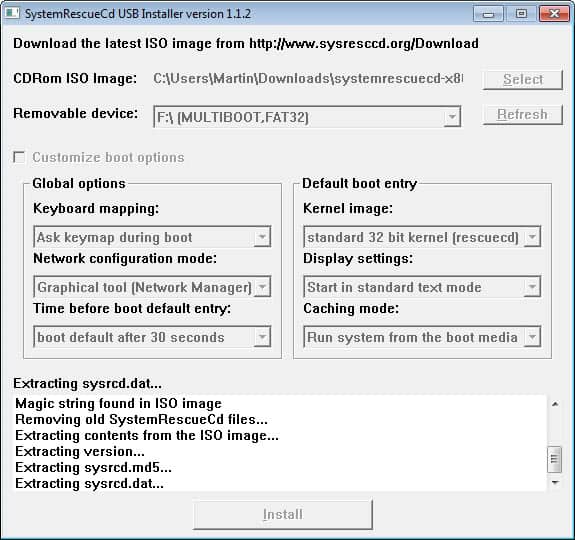
SystemRescueCd is a Linux system rescue disk available as a bootable CD-ROM or USB stick for administrating or repairing your system and data after a crash. It provides you with an easy way to carry out admin tasks on your computer, such as creating and editing the hard disk partitions. Sometimes though you may need something more powerful, for instance if you need to correct partitioning errors or recover files from a failing hard drive. System Rescue CD is a Linux Live CD that has been specifically designed for repair and rescue operations. You should not get too confused with the CD. This chapter explains how to install System. CD on a USB stick manually. If you prefer, you can order a pre- configured USB stick with the latest System. Cd already on it from the popular osdisc website. Installing System. Cd on an USB stick allows you to use the system from a USB stick (mini hard disk) instead of using a CD- ROM.
| Home | Switchboard | Unix Administration | Red Hat | TCP/IP Networks | Neoliberalism | Toxic Managers |
| May the source be with you, but remember the KISS principle ;-) Skepticism and critical thinking is not panacea, but can help to understand the world better | ||||||
| News | Recommended Links | Recommended Articles | Flash-drive based distributions | CD-based | SystemRescueCD | Knoppix | Floppy-based distributions |
| FAQs | Minidistibution toolkits | Executables compression | Dual boot | Limited memory, old hardware | Linux CD burning | Humor | Etc |
SystemRescueCd is a linux system on a bootable cdrom for repairing your system and your data after a crash. It also aims to provide an easy way to carry out admin tasks on your computer, such as creating and editing the partitions of the hard disk.
It contains a lot of system utilities (parted, partimage, fstools, ...) and basic ones (editors, midnight commander, network tools). It aims to be very easy to use: just boot from the cdrom, and you can do everything. The kernel of the system supports most important file systems (ext2/ext3, reiserfs, xfs, jfs, vfat, ntfs, iso9660), and network ones (samba and nfs).
- U Parted creates, resizes, moves, copies partitions, and filesystems (and more).
- GParted GUI implementation using the GNU Parted library.
- Partimage saves / restores partitions to an image file on another partition or to another system.
- File systems tools (e2fsprogs, reiserfsprogs, reiser4progs, xfsprogs, jfsutils, ntfsprogs, dosfstools): format, resize, and debug an existing partition of a hard disk
- Ntfs3g: enables read/write access to MS Windows NTFS partitions.
- sfdisksaves / restores partition table (and more).
- Test-disk tool to check and undelete partition, supports reiserfs, ntfs, fat32, ext2/3 and many others
- Network tools (Samba, NFS, ping, nslookup, ...)
SystemRescueCD is based on Gentoo and contains a stripped-down set of applications for system rescues. Needs Linux knowledge to operate. So it doesn't include OpenOffice or the Gimp or all of the other productivity applications that Knoppix has. You can get ISOs for x86, Sparc, and PowerPC. The x86 version is a mere 155 MB. Gui typically does not work (Xorg is installed).
Even better: You can boot and run SystemRescue from a USB stick. Newer systems support booting from USB devices; usually you need to go into the system BIOS to turn this on. It's not completely reliable, however; some systems seem to be allergic to booting from USB devices, so be sure to test it before you need it.
With SystemRescue you can copy files over the network, do serious network troubleshooting, read and write all the major filesystems including NTFS, manage partitions and filesystems, and do secure deletions. SystemRescue comes with my favorite data recovery tool, GNU ddrescue. This is the best utility for grabbing data off a failing hard drive. It is fast for a dd-based command, and smart enough to skip over bad blocks and keep going, looking for good blocks to copy.
The most surefire method I know requires a second local hard drive of equal or greater size; either SATA/PATA or USB. Then boot up SystemRescue and copy the first drive to the second drive. Of course you must replace the drive names in the example with your own drive names:
# ddrescue /dev/sda /dev/sdb
You may copy partitions instead of whole drives. Then run fsck on the second drive to check for and fix errors. Make sure it is not mounted, then run this command:
# fsck /dev/sdb
Add the -a option to tell fsck to automatically fix all errors. Use fsck only on Linux filesystems. For other filesystems you'll need their own native filesystem-consistency-fixing utilities.
Don't confuse GNU ddrescue with dd-rescue. They do the same thing and both do it well, but I think ddrescue is faster and more reliable.
GParted is the best partitioning and filesystem-creation application there is. Put it on a bootable medium and you can manage most Linux, Unix, Mac OS X, or Windows partitions and filesystems. Add the dd-based Clonezilla for cloning, and you have the ultimate power tool for new installations, restores, and replications. Clonezilla is an intelligent partition or disk-cloning program that works on any filesystem, because it operates at the block level. On supported filesystems (which are pretty much the same batch as GParted) it copies only used sectors. On unsupported filesystems it can't tell which ones are used, so it does a block-by-block copy. Either way you get your clones.
Download the torrent fromTuxDistro. (The other download sites don't seem to exist.) VisitGParted LiveCD for instructions on creating a bootable USB stick. This uses the same download.
Our Excellent Ancestors: Tomsrtbt and SuperRescueCD
Tomsrtbt, 'the most GNU/Linux on one floppy disk' was the first bootable live Linux on removable media. After all these years it is still useful. True, most computers these days don't even bother with a floppy drive, but for machines that still have them it's a great rescue diskette. It needs only 8 megabytes of RAM. It comes with everything you need for networking and copying files over the network, which is probably the #1 job for a rescue device. It has filesystem utilities, including Windows filesystems, and basic networking troubleshooting commands, so you can perform a surprising number of tasks from this tiny ancestor of bootable live Linuxes. Tomsrtbt has saved the day for me more times than I can remember.
H. Peter Anvin's SuperRescue CD was the first live Linux CD. Mr. Anvin is a bootloader guru, as well as a significant inventor or contributor in a number of projects. Super Rescue CD is based on Red Hat 7.2, so it's of limited usefulness on modern systems. But it's a nice tool for older systems; it only needs 24 megabytes of RAM and it handles older hardware without hassles. If you want X Windows, just type startx at the prompt and you get KDE. It's a funny-looking older KDE, but still the real deal.
SuperRescue CD pioneered on-the-fly compression/decompression, which is how you stuff 1.7 gigabytes of operating system and applications onto a single CD.
| Switchboard | |||||
| Latest | |||||
| Past week | |||||
| Past month | |||||
NEWS CONTENTS
- 190313 : [SOLVED] Partimage and ext4 ( Thread Tools )
Old news ;-)
[SOLVED] Partimage and ext4
Thread Tools
Display
- January 14th, 2011 #1ceperman Spilled the Beans
- Join Date
- Mar 2008
- Beans
- 16
Adv ReplyPartimage and ext4
I've been using PING (which I understand uses Partimage under the covers) for a little while to back up an ext4 partition. I've just become aware that Partimage doesn't support ext4, so I'm confused as to why it appears to be working (although I've not tried to restore it).
The Disk Utility (version 2.30.1) on Ubuntu 10.10 reports the partition as Ext4 (version 1.0). However, PING and GParted report it as ext3fs, which may explain why Partimage is processing it. As far as I'm concerned it should be ext4 as that's what I selected during installation.
What's going on?
- January 14th, 2011 #2indytim Grande Half-n-Half Cinnamon Ubuntu
- Join Date
- Nov 2005
- Location
- Carmel, Indiana U.S.A.
- Beans
- Hidden!
- Distro
- Ubuntu 8.04 Hardy Heron
Re: Partimage and ext4
The last time I checked the Partimage website, it was plainly stated that Partimage does not support ext4 or NTFS. As I recall, there is no plans to move to this support.
I have been using fsarchiver quite successfully for about 9 months. I supports most common file system types (including ntfs and ext4). Even though it is still classified as 'in development' I have found it both stable and reliable. I have restored numerous ext4 and ntfs partitions with no lingering issues.
If you're interested, I've authored a small 'white paper' on the subject. See the Backup Strategy Ver 2 link in my sig. Also not the comment attached to the paper for an important update.
Hope this helps.
IndyTim / DataMan
New Build : Core 2 Quad, 8G RAM, 1.75TB Storage ... it's fun!
GRUB PartitionLinux Backups- Ver2Easy LAMP Install
Linux ID 422356 Ubuntu User 15015
[Oct 23, 2011]Weekend Project Rescue Failing Drives With SystemRescue Linux.com
When a hard drive, CD/DVD, USB stick, or any digital storage media is on its way to the Great Bitbucket in the Sky, GNU ddrescue is my favorite data recovery tool. GNU ddrescue is included in the default SystemRescue image. Before we dive into the fun stuff, there is some vexing naming confusion to clear up. There are two ddrescue programs in SystemRescue. GNU ddrescue, by Antonio Diaz, is the one I prefer. The version on the current SystemRescue release is ddrescue 1.14. There is also a dd_rescue, version 1.23, by Kurt Garloff. dd_rescue is nice, but it's slower than ddrescue and doesn't include as many features.
Just to keep it interesting, Debian Linux adds its own bizarre naming conventions. The Debian package name for GNU ddrescue is gddrescue, and the package name for dd_rescue is ddrescue. But the binary for gddrescue is /sbin/ddrescue, and the binary for dd_rescue is /bin/dd_rescue. Fortunately, SystemRescue doesn't mess with the original binary names, and calls them /usr/bin/ddrescue and /bin/dd_rescue.
Enough of that; let's talk about what makes GNU ddrescue my favorite. It performs block-level copies of the failing media, and so it doesn't matter what filesystem is on the media. You're probably thinking it sounds like the venerable dd command, and it is similar, with some significant improvements. dd works fine on healthy disks, but when it encounters a read error it stops, and you have to manually restart it. It reads the media sequentially, which is very slow, and if there are a lot of bad blocks it may never complete a full pass.
GNU ddrescue is fully automatic and fast for a block-level copy program, and you want speed when a drive full of important data is dying. It seeks out good blocks to copy and skips over the bad blocks. It optionally records all activity in a logfile, so you can resume where you left off if the copying is interrupted for any reason. It is best to always generate a logfile, because every time you power up the failing drive the more likely it is to die completely. Using a logfile ensures that ddrescue will not repeat operations, but will move on and look for new good blocks to copy.
When you are rescuing a failing drive, the first step is to copy it with ddrescue. Then take the original offline, and perform any additional recovery operations on the copy. Don't touch the original any more than you have to. You can copy the copy as many times as you need for insurance.
You need a healthy drive to copy your rescued data to. I prefer USB-attached media such as a USB hard drive, USB thumb drive, Compact Flash, or SD cards. Of course a second internal hard drive is a good option, or this might be your chance to finally use that eSATA port that always looked like it should be cool and useful, but you never found a reason to use it. Your second drive should be at least 50% larger than the drive you're recovering. The troubled drive must not be mounted. The simplest invocation looks like this:
# ddrescue /dev/sda1 /dev/sdb1 logfile
Here, /dev/sda1 is a partition on the failing drive. Everything on /dev/sdb1 will be overwritten, and the logfile will be written to /dev/sdb1. You can name the logfile anything you want. You can rescue an entire drive if you prefer, like this:
# ddrescue /dev/sda /dev/sdb logfile
Note that if there is more than one partition on the failing drive and the partition table is damaged, you will have to re-create it on the rescue drive. I copy one partition at a time to avoid this sort of drama.
You can have ddrescue make multiple passes with the -r option; sometimes you can make a more complete recovery this way. You can go as high as you want; I use 3-5:
# ddrescue -r5 /dev/sda2 /dev/sdb1 logfile
Sometimes ddrescue is nearly magical for rescuing scratched CDs and DVDs. The first command copies the disk, and the second command copies it to a blank disk:
You can give the image file whatever name you like. While I've never needed to go beyond the basics in this article, ddrescue has a whole lot of other capabilities that you can learn about in the GNU ddrescue manual.
SystemRescueCd 1.1.0 Packed with New Utilities - Features advanced customization and the backing-store filesystem
Softpedia
,SystemRescueCd is based on Gentoo and, now, with this version, you can add the packages of your choice using Gentoo's package manager. This is present here by including development tools (like gcc, automake, autoconf, etc.) and specific Gentoo-Linux applications (such as emerge, autoconf, etc.) required in order to install new packages, as all that is installed on Gentoo must be compiled.
SystemRescueCd includes 4 kernels, 2 standard ones (rescuecd and rescue 64) and 2 alternative ones (altker32 and altker64). Now, you have the possibility to compile which kernel you want, to best fit your needs. This is usually performed if you'd like more recent sources or you need another driver, or you simply need various compilation options.
Another clever utility we find in this version is the backstore, primarily used to keep the changes after a reboot. A backing-store is a loopback filesystem containing all the changed files of a system. Every minor file change like a file edit, creation or deletion, is recorded on the backing-store, so you just have to load the appropriate one to return to the state you want.
Now, let's have a look at a list with some of the highlights of SystemRescueCd 1.1.0:
· The two kernel sources, standard and alternative, have been swapped;
· The majority of drivers are compiled as module in the standard kernels (2.6.25.16);
· The majority of drivers are built-in the alternative kernels (2.6.25.14);
· The necessary development tools (gcc, make, ...) and Gentoo tools (emerge, equery, ...) have been added;
· The nameif option has been added, which can be used to specify the name of each ethernet interface using the mac address (ex: 'nameif=eth0!00:0C:29:57:D0:6E,eth1 00:0C:29:57:D0:64');
· Support for backing-store loopback file systems has been introduced;
· Added support for the speakup (support devices for blind people).
You can find more information regarding the new features and updates by visiting the official changelog.
Main Page - SystemRescueCd
New features introduced in SystemRescueCd-1.1.0
- advanced customization: You can now install new packages to SystemRescueCd by doing an advanced customization.
- kernel recompilation: There is a new documentation about building a customized SystemRescueCd with your own kernel
- backstore: It allows you to keep your changes when you reboot sysresccd
- nameif: It allows you to specify the name of each ethernet interface using the mac address.
- rsync tutorial: Here is a new documentation about how to use rsync
Features introduced in SystemRescueCd-1.0.x
- You can now install new packages to SystemRescueCd by doing an advanced customization.
- How to use Xvesa when Xorg fails to start, so that you can always get the graphical environment to work.
- New chapter in the handbook that explains How to manage remote servers using SystemRescueCd
- The GPT disklabel is the new generation partition table that supports large disks (over 2TB) and more than four partitions.
- The autorun feature has been rewritten. It supports more options and scripts can be downloaded from an http web server.
- Network booting via PXE can download the sysrcd.dat filesystem through TFTP as well as HTTP
- SystemRescueCd-1.0.1 is now based on unionfs and it comes with JWM as the default windows mananager.
SystemRescueCd View topic - Linux disk editor
Hello.
Firstly, thank you for your efforts in creating such a useful collection in a package that works so well. I love it and think it's a great system rescue tool.
Will you please consider including the Linux Disk Editor (http://lde.sourceforge.net/) in the next release of SystemRescue CD. I use it for recovering 'lost' partitions that parted won't even look at (yes I use 1.6.6 from your 0.2.8 CD). I use the statically linked lde-i386, as downloaded directly from SourceForge, and run it from a floppy after booting from your SystemRescue CD.
Incidentally, to really mess up a disk's partitions, just create them with parted, then load Partition Magic and let it 'fix' the 'misalignment' errors it finds, then watch as neither Partition Magic, nor parted will look at the disk again. It doesn't always happen, but sometimes yes. One way to avoid this is if only one person with one set of tools works on a system. Not always possible unfortunately.
To fix this, I use gpart to give me a list of 'possible' partition locations, use linux disk editor to view the contents of the partition tables, and a calculator to determine the 'actual' table locations, then linux disk editor again to edit the tables so they work. Tedious, but such a relief (especially for the owner) when it all works again.
I used to boot a DOS floppy and use Norton Disk Editor, but I much prefer to stay within Linux and use Linux tools.
Thank you for your consideration.
Andrew
Recommended Links
Google matched content |
Softpanorama Recommended
Top articles
Sites
SystemRescueCd (SourceForge)
Recovery disc - Wikipedia, the free encyclopediaLinuxPlanet - Tutorials - Become A System Rescue Guru With Linux, Part 1 - SystemRescue CD, the Ultimate Rescue Power ToolCarla Schroder
Thursday, May 15, 2008 11:44:01 AM
Etc
Society
System Hard Disk Manager
Groupthink : Two Party System as Polyarchy : Corruption of Regulators : Bureaucracies : Understanding Micromanagers and Control Freaks : Toxic Managers : Harvard Mafia : Diplomatic Communication : Surviving a Bad Performance Review : Insufficient Retirement Funds as Immanent Problem of Neoliberal Regime : PseudoScience : Who Rules America : Neoliberalism : The Iron Law of Oligarchy : Libertarian Philosophy
Quotes
War and Peace: Skeptical Finance : John Kenneth Galbraith :Talleyrand : Oscar Wilde : Otto Von Bismarck : Keynes : George Carlin : Skeptics : Propaganda : SE quotes : Language Design and Programming Quotes : Random IT-related quotes : Somerset Maugham : Marcus Aurelius : Kurt Vonnegut : Eric Hoffer : Winston Churchill : Napoleon Bonaparte : Ambrose Bierce : Bernard Shaw : Mark Twain Quotes
Bulletin:
Vol 25, No.12 (December, 2013) Rational Fools vs. Efficient Crooks The efficient markets hypothesis : Political Skeptic Bulletin, 2013 : Unemployment Bulletin, 2010 : Vol 23, No.10 (October, 2011) An observation about corporate security departments : Slightly Skeptical Euromaydan Chronicles, June 2014 : Greenspan legacy bulletin, 2008 : Vol 25, No.10 (October, 2013) Cryptolocker Trojan (Win32/Crilock.A) : Vol 25, No.08 (August, 2013) Cloud providers as intelligence collection hubs : Financial Humor Bulletin, 2010 : Inequality Bulletin, 2009 : Financial Humor Bulletin, 2008 : Copyleft Problems Bulletin, 2004 : Financial Humor Bulletin, 2011 : Energy Bulletin, 2010 : Malware Protection Bulletin, 2010 : Vol 26, No.1 (January, 2013) Object-Oriented Cult : Political Skeptic Bulletin, 2011 : Vol 23, No.11 (November, 2011) Softpanorama classification of sysadmin horror stories : Vol 25, No.05 (May, 2013) Corporate bullshit as a communication method : Vol 25, No.06 (June, 2013) A Note on the Relationship of Brooks Law and Conway Law
History:
Fifty glorious years (1950-2000): the triumph of the US computer engineering : Donald Knuth : TAoCP and its Influence of Computer Science : Richard Stallman : Linus Torvalds : Larry Wall : John K. Ousterhout : CTSS : Multix OSUnix History : Unix shell history : VI editor : History of pipes concept : Solaris : MS DOS : Programming Languages History : PL/1 : Simula 67 : C : History of GCC development : Scripting Languages : Perl history : OS History : Mail : DNS : SSH : CPU Instruction Sets : SPARC systems 1987-2006 : Norton Commander : Norton Utilities : Norton Ghost : Frontpage history : Malware Defense History : GNU Screen : OSS early history
Classic books:
The Peter Principle : Parkinson Law : 1984 : The Mythical Man-Month : How to Solve It by George Polya : The Art of Computer Programming : The Elements of Programming Style : The Unix Hater’s Handbook : The Jargon file : The True Believer : Programming Pearls : The Good Soldier Svejk : The Power Elite
Most popular humor pages:
Manifest of the Softpanorama IT Slacker Society : Ten Commandments of the IT Slackers Society : Computer Humor Collection : BSD Logo Story : The Cuckoo's Egg : IT Slang : C++ Humor : ARE YOU A BBS ADDICT? : The Perl Purity Test : Object oriented programmers of all nations : Financial Humor : Financial Humor Bulletin, 2008 : Financial Humor Bulletin, 2010 : The Most Comprehensive Collection of Editor-related Humor : Programming Language Humor : Goldman Sachs related humor : Greenspan humor : C Humor : Scripting Humor : Real Programmers Humor : Web Humor : GPL-related Humor : OFM Humor : Politically Incorrect Humor : IDS Humor : 'Linux Sucks' Humor : Russian Musical Humor : Best Russian Programmer Humor : Microsoft plans to buy Catholic Church : Richard Stallman Related Humor : Admin Humor : Perl-related Humor : Linus Torvalds Related humor : PseudoScience Related Humor : Networking Humor : Shell Humor : Financial Humor Bulletin, 2011 : Financial Humor Bulletin, 2012 : Financial Humor Bulletin, 2013 : Java Humor : Software Engineering Humor : Sun Solaris Related Humor : Education Humor : IBM Humor : Assembler-related Humor : VIM Humor : Computer Viruses Humor : Bright tomorrow is rescheduled to a day after tomorrow : Classic Computer Humor
The Last but not LeastTechnology is dominated by two types of people: those who understand what they do not manage and those who manage what they do not understand ~Archibald Putt. Ph.D
Copyright © 1996-2018 by Dr. Nikolai Bezroukov. www.softpanorama.org was initially created as a service to the (now defunct) UN Sustainable Development Networking Programme (SDNP) in the author free time and without any remuneration. This document is an industrial compilation designed and created exclusively for educational use and is distributed under the Softpanorama Content License. Original materials copyright belong to respective owners. Quotes are made for educational purposes only in compliance with the fair use doctrine.
FAIR USE NOTICEThis site contains copyrighted material the use of which has not always been specifically authorized by the copyright owner. We are making such material available to advance understanding of computer science, IT technology, economic, scientific, and social issues. We believe this constitutes a 'fair use' of any such copyrighted material as provided by section 107 of the US Copyright Law according to which such material can be distributed without profit exclusively for research and educational purposes.
This is a Spartan WHYFF (We Help You For Free) site written by people for whom English is not a native language. Grammar and spelling errors should be expected. The site contain some broken links as it develops like a living tree...
| You can use PayPal to make a contribution, supporting development of this site and speed up access. In case softpanorama.org is down you can use the at softpanorama.info |
Disclaimer:
The statements, views and opinions presented on this web page are those of the author (or referenced source) and are not endorsed by, nor do they necessarily reflect, the opinions of the author present and former employers, SDNP or any other organization the author may be associated with.We do not warrant the correctness of the information provided or its fitness for any purpose.
The site uses AdSense so you need to be aware of Google privacy policy. You you do not want to be tracked by Google please disable Javascript for this site. This site is perfectly usable without Javascript.
Last modified:March 12, 2019
THE BEST! Finally a turning point in System Rescue CD development! The 6.0.0 version is stunning and shows that this project is alive and the SysRescCD is still one of the best (it's my favorite) admin tools around. This version is now based on Arch instead of Gentoo and here we can find all the software updated to the last version: Updated kernel to Long-Term-Supported linux-4.19.19 ddrescue 1.23 partclone 3.11 fsarchiver 0.8.5 gparted 0.33 firefox 65 and many more. 32 bit has been dropped and now it works on 64 bit only (for 32 bit you can still use the 5.3.2 version). A 'second birth' for System Rescue CD! Thank you!
Amazing collection of tools in a small package. I always have a partition reserved for SystemRescueCd on my key chain thumb drive. However, the 6.0.0 release is now based on Arch Linux (which is great), but the installation procedure also changed. The documentation seems out of date. I used to use `./usb_inst.sh` to format the partition, copy the new files and make the partition bootable. But I can't find any installation scripts anymore. How to proceed? EDIT: I see that the documentation has been updated now, thanks!
Rated 5 stars but have an issue in that there is NO WAY to report bugs on the projects main site. Your 'contact us' link does not lead to any way to leave a message and there is absolutely NO WAY to register on the forums. This tells me you dont care one iota for what people have to say, even when its a BUG REPORT. BUG REPORT-> When installing Gentoo using the system rescue cd the numpy ebuild will not build after doing the chroot into the extracted base system. Numpy it seem will not build under zsh and even doing chroot /mnt/gentoo /bin/bash and switching in to bash the SHELL environment variable still says /bin/zsh. WHO THE HELL uses zsh anyway? It took me 5 days to find out that all i needed to do was export SHELL=/bin/bash and numpy would build. While this is technically not a system rescue cd bug EVERYONE uses /bin/bash and so should the system rescue cd. The only reason I can see for it using zsh is for the same reason you use that putrid yellow background in your x terminal... i.e. just to be different! Please consider switching to using a SANE shell? Also, please consider enabling bug reporting SOMEWHERE??? ty
Saved my ass yesterday, when I did an mkfs on the wrong disk. Restored from backup without much trouble.